It is 11:40 pm at a mid-size OTA. A storm has just shut down a major hub airport. Two hundred flights are cancelled. Within minutes, the support queue jumps from 40 tickets to 4,000. Phone lines are jammed. Travellers are stuck at gates, refreshing an app that shows them nothing. Agents copy booking references between three different systems, trying to re-book people one by one.
Everyone who works in travel knows this night. It happens every season. And it is the clearest proof of an uncomfortable truth: the travel industry sells joy, but runs on systems that break exactly when travellers need them most.
Whether you build an online travel agency, manage a tour operator, or rely on custom software for travel agencies to handle bookings, itineraries, supplier integrations, and customer support, these moments expose the same weakness. Technology is supposed to absorb the chaos, not create more of it. Yet many travel businesses still depend on disconnected systems that struggle when demand spikes or disruptions occur.
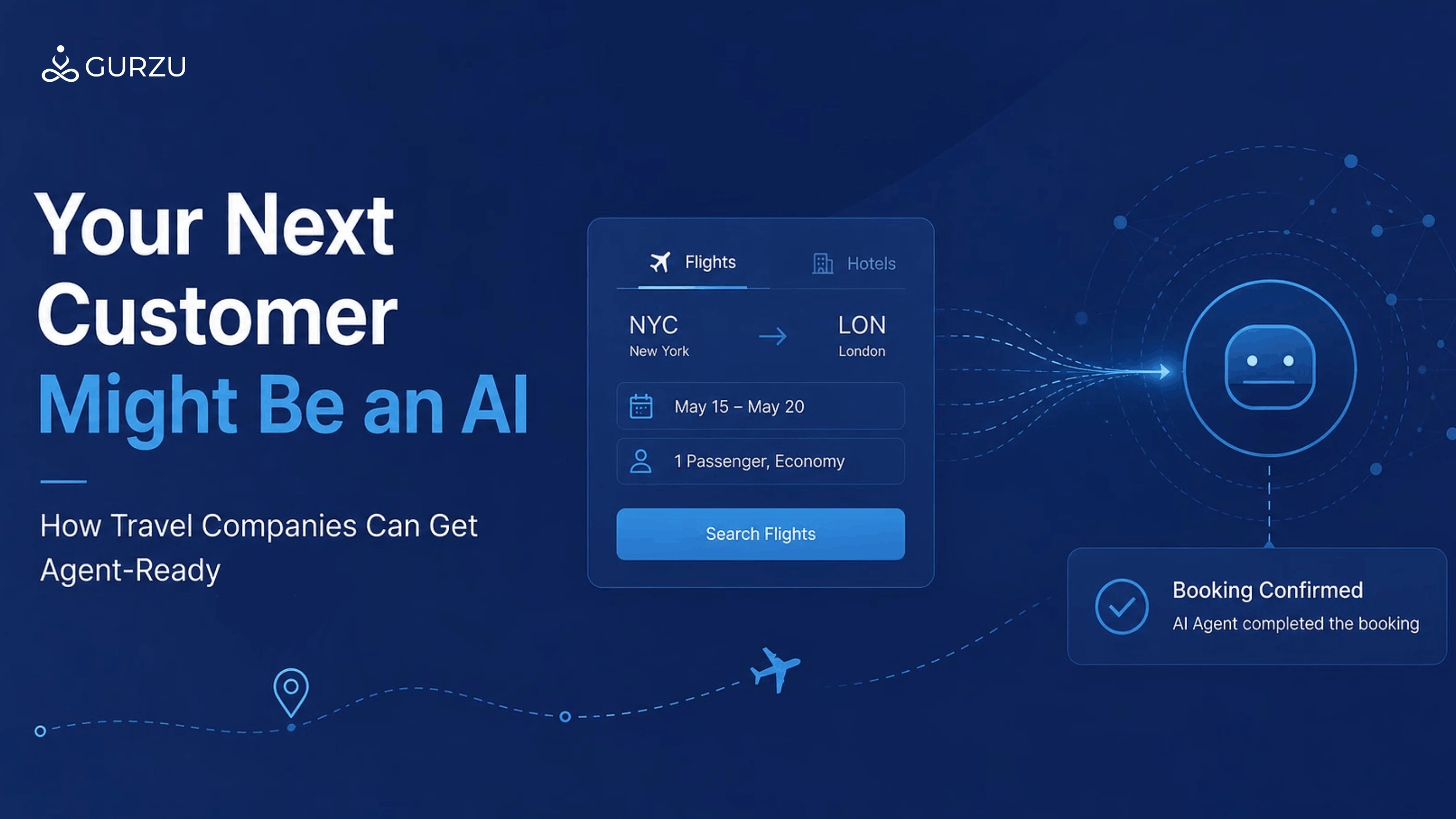
Now add one more change on top of this. In 2026, more and more bookings will be influenced or completed by AI-powered booking agents acting on behalf of travellers.
Whether you’re running an OTA, a travel agency, a tour operator, or a travel management company, today’s challenges demand software built specifically for travel. Modern TravelTech solutions unify bookings, GDS integrations, supplier APIs, payment gateways, and customer support into one platform, helping travel businesses operate more efficiently, scale faster, and respond better when disruptions happen.
The Quiet Shift Nobody Planned For
Travel industry has adapted to major technological shifts before, but the next one is happening more quietly.
As agentic AI in travel becomes increasingly capable of searching, comparing, and booking travel on behalf of users, the way customers discover and interact with the travel businesses has began to change. It is a fundamental shift in customer journey for travel companies.
How Travel AI Agents Are Changing the Customer Journey?
A growing number of travellers now plan trips like this: they open an AI assistant and say, “Find me a beach holiday under $800 next month and book the best one.”
They never visit your homepage. They never see your banner, your flash sale, your loyalty pop-up. Their AI agent (a software program that acts for them) talks directly to travel platforms through APIs, the doorways that let one system talk to another. It pulls prices, compares options, reads cancellation rules, and books. The traveller just gets a confirmation.
Why This Feels Familiar to the Travel Industry?
For OTAs, this is history repeating itself. Twenty years ago, it disrupted travel agents by moving bookings online.
Today, AI travel agents are doing the same thing to OTAs. The layer between the traveller and the trip is changing again.
The companies that panicked last time lost. The companies that adapted became the giants we know today. Same choice, new decade.
Travel Industry’s Biggest Operational Challenges
If you run or build travel technology, at least three of these will feel personal.
1. Disruption handling is still mostly manual
When flights cancel, most platforms still depend on humans to re-book, refund, and reply. Industry studies have estimated that flight disruptions cost the travel industry tens of billions of dollars every year. But the bigger cost is invisible: the traveller who waited four hours for a reply and swore never to book with you again.
2. Content is fragmented across too many sources
A single hotel can come to your platform through a travel GDS (Global Distribution System, the large networks like Amadeus, Sabre, and Travelport that hold flight and hotel inventory), through a bed bank, through a channel manager, and through a direct API. Same hotel, four sources, four slightly different names.
3. NDC has made things better and messier at the same time
NDC (New Distribution Capability, the newer standard airlines use to sell their fares directly) gives access to richer offers and better prices. But every airline implements it a little differently. Many mid-size platforms are running old GDS connections and new NDC connections side by side, and the two do not always agree.
4. Search traffic is exploding, bookings are not
The look-to-book ratio, the number of searches your system answers for every real booking, has been climbing for years. AI tools and price scrapers now hammer travel APIs day and night. You pay for the servers that answer millions of searches from “customers” who were never going to book.
5. Refunds are still painfully slow
Travellers can order food and see the driver on a live map, but after a cancelled flight they can wait weeks for money back, with no visibility. Every day of silence turns a refund into a complaint, and a complaint into a one-star review. These are not new problems. What is new is that AI agents make every one of them more urgent, and, handled well, more solvable.
Why AI in Travel Industry changes the game?
Here is the strange part. The AI agent that scares the industry might be the best customer travel has ever had.
Human shoppers abandon carts. In travel, roughly 8 out of 10 started bookings are never completed. People get confused by the fifth form field, get scared by a fee that appears at checkout, or simply get distracted.
An AI agent does none of that. It does not get tired at step four. It does not need a countdown timer to decide. It does not call support to ask what “non-refundable” means. It needs exactly one thing from you: a platform that is fast, clear, and honest.
But there is no loyalty and no forgiveness either. If your API answers in six seconds and a competitor answers in one, the agent books with the competitor. Every time. It will not remember your brand from a TV ad. To an AI agent, your brand is your response time, your data quality, and your final price.
That is what “agent-ready” really means.
The Agent-ready Checklist
1. Make search fast, and keep it fast under pressure
For an AI agent, a slow answer is the same as no answer. Your search and pricing APIs need to respond quickly even during peak load and disruption events, which is exactly when everyone searches at once. Caching, smart rate limiting, and solid infrastructure are not backend details anymore. They are your storefront.
2. Clean up your content once, properly
Humans can guess that “Deluxe Sea View (breakfast incl.)” and “Sea View Deluxe with Breakfast” are the same room. Machines cannot. Agent-ready platforms invest in structured, well-mapped content: one clear record per room, fare, and rule, no matter how many GDS, NDC, or bedbank sources it came from. It is boring work, and it is the single biggest advantage in the agent era.
3. Show the true price first
AI agents compare final prices across platforms in milliseconds. A room that shows $99 and becomes $131 at checkout does not just annoy the agent. It teaches the agent that your data cannot be trusted, and it stops sending you travellers. Drip pricing was always bad for humans. For agents, it is disqualifying.
4. Put AI agents on your side of the counter too
Remember that storm night from the beginning? This is where it changes. Modern platforms now run their own AI agents in customer handling. When a flight cancels, the system finds affected bookings, checks re-booking options across GDS and NDC sources, offers alternatives, and messages travellers before they even reach the gate agent. Refund status, date changes, and common questions get answered instantly, in the traveller’s own language, at any hour. Human agents stop drowning in repeat questions and focus on the genuinely hard cases where empathy matters.
The end state is quietly remarkable: the traveller’s AI agent asks your platform’s AI agent for a date change, and the whole thing is done in seconds while the traveller sleeps. No queue, no hold music, no ticket number.
The Winners will not be the Biggest. They will be the Easiest
For twenty years, marketing budgets decided who won in online travel. AI agents do not watch ads. They measure speed, clarity, and honesty. That means a well-built mid-size platform can now out-compete a giant with a slow, messy stack. This has genuinely never been true before, and it will not stay true forever. The window belongs to whoever moves first.
Getting agent-ready is not one giant, scary project. It is a sequence of practical steps: faster search, cleaner content, transparent pricing, and intelligent automation in customer handling. Each step also fixes a pain your human customers have been quietly suffering for years. That is the real beauty of it. Building for AI agents forces you to build the platform travellers always deserved.
Choosing the Right Technology Partner
Becoming agent-ready is, at its heart, an engineering journey, and the partner you choose will matter as much as the plan. The right partner is rarely the one with the loudest pitch. It is the one that genuinely understands both sides of this shift: the AI in travel that is changing how bookings happen, and the quality engineering that keeps a platform standing when a million searches hit it at once.
A simple test: look at what a partner shares, not just what they sell. Deciding what to automate starts with understanding how modern AI actually works under the hood, which is why we broke down Mixture of Experts: The Architecture Behind Today’s Biggest AI Models, the design that lets today’s frontier AI models be enormous in size yet cheap to run.
That is exactly the kind of efficiency thinking travel platforms need, because in this industry, every millisecond and every server dollar counts. And since speed means nothing without reliability, we also wrote about QA as a Service: The Shift from Traditional Testing to Quality Engineering, on why testing only at the end of development can no longer protect fast-moving platforms, and how continuous quality engineering keeps every release safe.
Read how we helped achieve 100% test automation coverage in six months in our Access Test Automation case study
A partner thinking about both, intelligence and reliability, is a partner thinking about your traveller.
Helping Travel Companies Become Agent-Ready
At Gurzu, we have spent years working alongside international partners, GDS companies, and API providers across the travel ecosystem, connecting the moving pieces so that things feel seamless to the traveller. Our work covers the journey from start to finish: search, booking, disruption handling, and the communication in between, so that no traveller ever feels left behind, and the conversation with a travel brand feels as smooth as the journey itself.
Because in 2026, your next booking might come from a person dreaming at their desk, or from an AI agent acting on their behalf. Either way, your platform should be ready to say yes.
If you are thinking about making your travel platform agent-ready, you can a short discovery call with our team and let’s discuss how to prepare your travel platform for the next generation of bookings.