Software development today moves fast. Teams release frequently, systems are more complex, and users expect consistent performance across web, mobile, APIs, and connected devices.
In this environment, traditional QA approaches, where testing happens only at the end of development, are no longer enough.
Modern teams need a continuous and structured approach to quality.
This is where QA as a Service (QAaaS) becomes relevant.
What is QA as a Service?
QA as a Service is a modern quality engineering approach where testing is integrated into the entire software delivery lifecycle, not treated as a final phase.
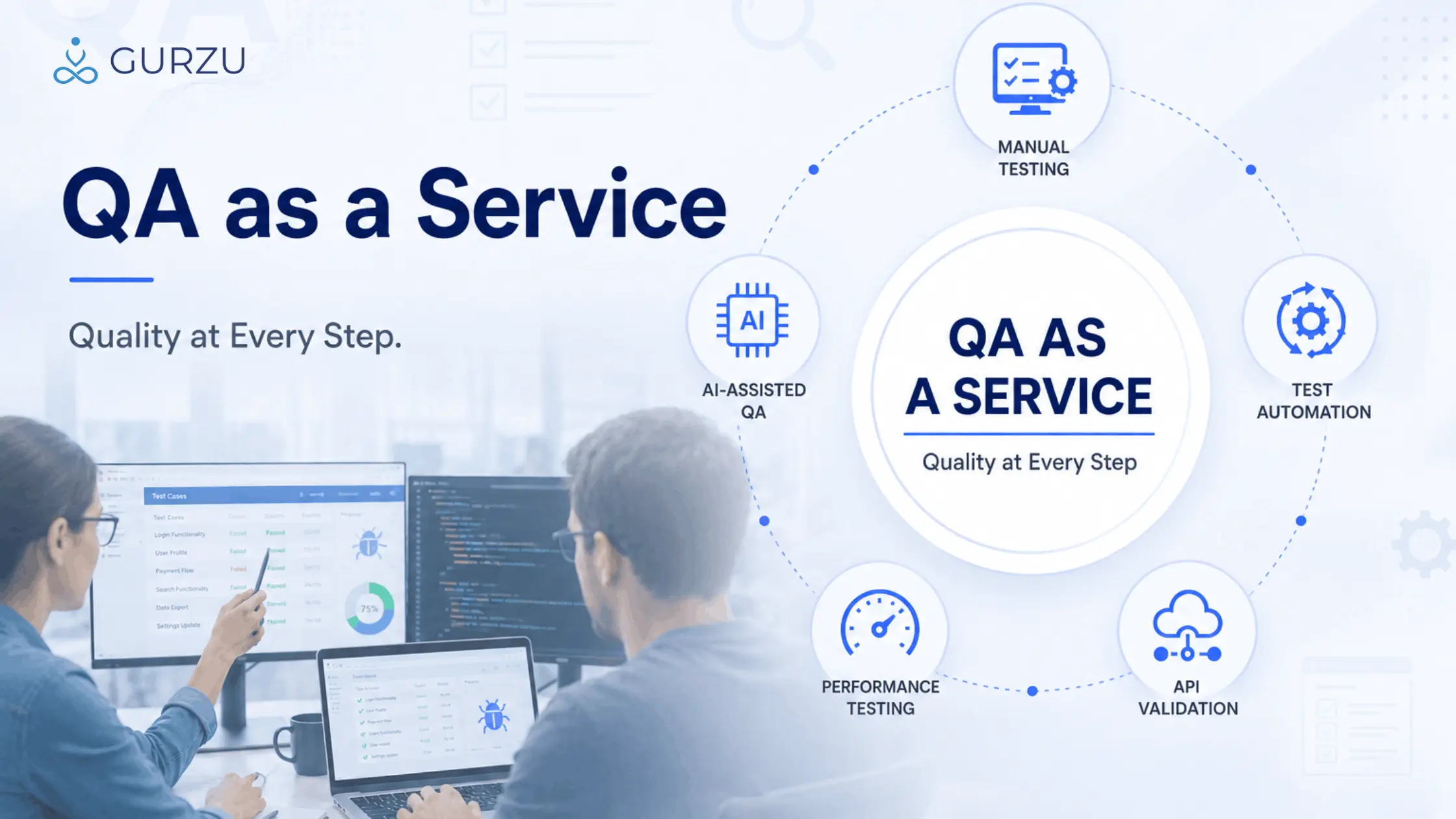
Instead of focusing only on executing test cases, QAaaS focuses on building a quality system that ensures:
- Early detection of risks
- Continuous validation during development
- Stable regression coverage
- Clear visibility into release readiness
- Alignment across product, engineering, and QA
In simple terms, QA testing as a service shifts QA from a task-based activity to an engineering-driven discipline.
The QA as a Service Approach at Gurzu
At Gurzu, Quality Assurance as a service is designed as a structured quality engineering model that adapts to each product, team, and release process.
1. Building a Quality System
Instead of isolated testing activities, we establish a complete quality system that includes:
- QA strategy and planning
- Risk-based testing
- Continuous validation
- Automation integration
- Release readiness reporting
This ensures quality is consistent across the entire software bug life cycle.
2. Automation with Reuse and Scalability
Automation is essential, but it must be sustainable.
Rather than rebuilding automation frameworks from scratch for every project, we reuse proven components and scalable frameworks developed across engagements.
This helps teams:
- Reduce onboarding time
- Improve regression coverage faster
- Maintain stable automation suites
- Lower long-term maintenance effort
Automation is focused on high-value areas such as regression cycles, smoke testing, and critical user journeys.
3. Domain-Aware Quality Engineering
Different products carry different risks, so testing must adapt accordingly.
For example:
- E-commerce platforms require strong validation of checkout and payment flows
- Security systems require deep focus on authentication, authorization, and audit trails
- BLE and wearable systems depend on connectivity and sensor accuracy
- Travel platforms rely heavily on search, pricing, and booking workflows
Instead of a generic checklist, QAaaS is tailored to the product domain to ensure meaningful coverage.
Check out this case study:
Who Benefits from QA as a Service?
QA as a Service (QAaaS) is designed for organizations that need to maintain high software quality while keeping pace with evolving business demands.
Whether you’re launching new features, scaling products, or managing complex applications, QAaaS provides the expertise, processes, and tools needed to ensure reliable releases. \ \ QAaaS is most valuable for teams that are:
- Fast-growing and shipping frequently
- Struggling with unstable releases or regressions
- Scaling across web, mobile, API, and devices
- Lacking structured QA or automation maturity
- Looking to improve release confidence and predictability
Core QA Coverage Areas
QA as a Service typically includes:
- Functional and exploratory testing
- API testing and validation
- Web and mobile testing
- AI product quality validation
- Automation for regression and critical flows
- Device, BLE, and NFC testing
- Performance validation
- Bug reporting and verification
- Release readiness evaluation
Each layer contributes to reducing uncertainty before release.
QA as a Continuous Process
QAaaS is not a one-time activity, it is a continuous cycle:
1. Understand the Product
Workflows, users, and risk areas are analyzed.
2. Define QA Strategy
A tailored testing approach is designed.
3. Execute Continuously
Testing happens throughout development.
4. Provide Visibility
Clear reporting of risks and quality status.
5. Support Release Decisions
Helping teams decide readiness with confidence.
6. Improve Over Time
Test coverage and automation evolve with the product.
Tool-Agnostic Integration
QAaaS integrates with existing tools rather than replacing them.
Typical tools include:
- Jira, Linear, GitHub Issues
- Cypress, Playwright, Selenium
- Appium for mobile automation
- Postman and Swagger for API testing
This ensures QA improves workflows without disrupting existing systems.
Business Outcomes
QA as a Service delivers measurable impact:
- Faster and more reliable release cycles
- Reduced production defects
- Lower cost of regression and maintenance
- Improved product stability and user experience
- Better visibility into release readiness
Take a look at our manual and automated testing case study on OneOS
Why Gurzu for QA as a Service?
Gurzu’s approach combines engineering discipline with real-world delivery experience. Gurzu’s QA Automation Testing services can combine human expertise with automated systems to ensure every release is thoroughly reviewed from both functional and technical perspectives.
What makes us different:
- Domain-aware QA across complex systems
- Flexible engagement models based on product needs
- Strong balance of manual, automation, and API testing
- Tool-agnostic integration into existing workflows
- Focus on risk, not just test execution
We work as an embedded quality partner, helping teams release with confidence and consistency.
Conclusion
As software systems continue to grow in complexity, traditional QA approaches are no longer sufficient.
QA as a Service introduces a structured, continuous, and scalable approach to quality engineering.
By combining strategy, automation, domain awareness, and continuous testing, teams can deliver software with greater confidence and fewer surprises.
The result is not just better testing, it is also about better software delivery.