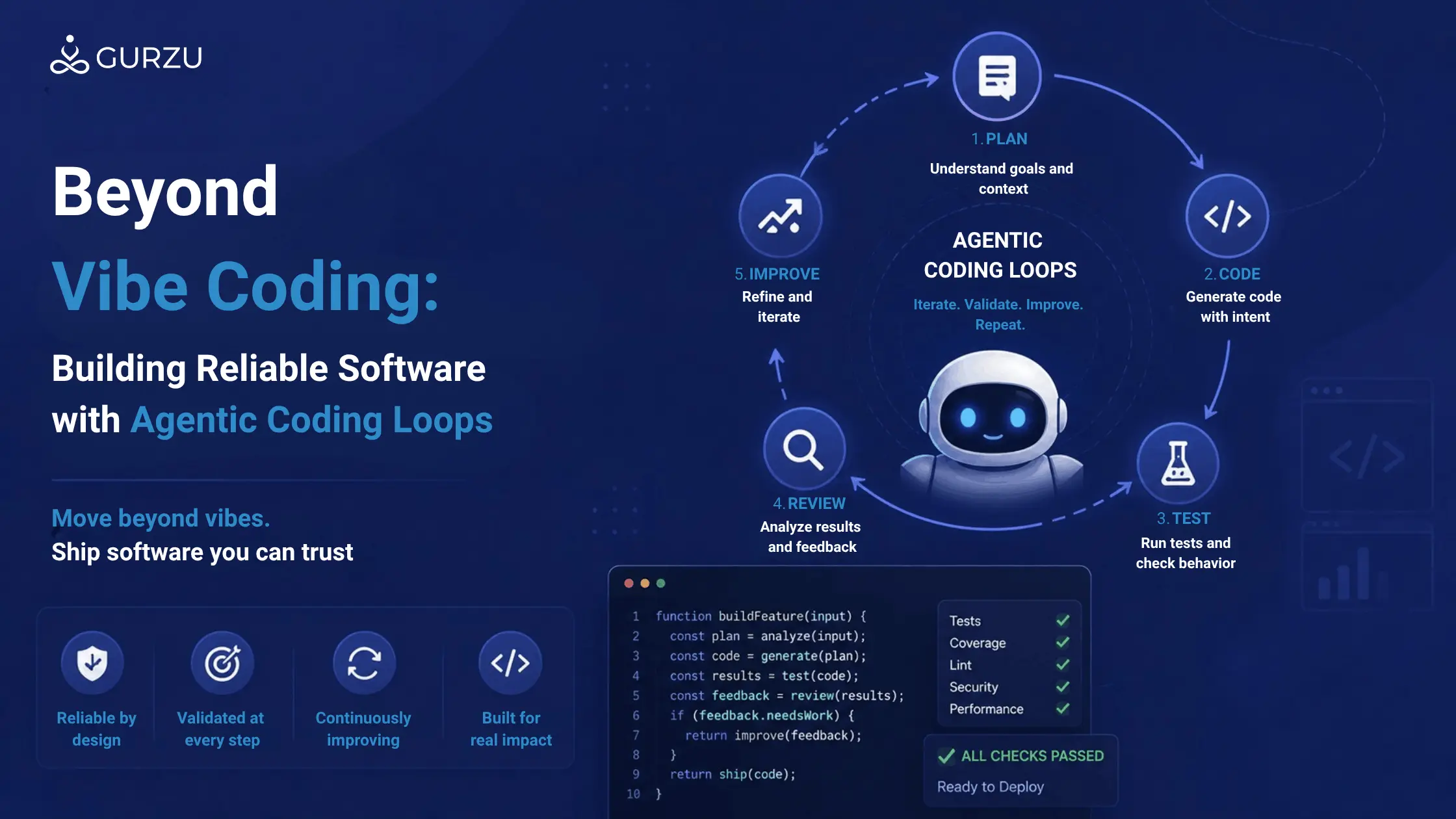
Introduction: Fast Code Is Not the Same as Reliable Software
AI coding tools have made it easier than ever to move from an idea to a working diff. You can describe a feature, ask an agent to inspect the codebase, and watch it update files, generate tests, and explain its changes. For engineers, that speed is useful. But speed alone is not the same as reliability.
Most engineers who have used AI coding tools for more than a few days have seen both sides of the experience. Sometimes the agent produces a clean patch that saves hours. Other times it changes too much, skips an edge case, invents a pattern that does not fit the codebase, or confidently says the task is done when no meaningful verification happened.
This is where the difference between casual vibe coding and disciplined agentic coding becomes important. Vibe coding can be useful for exploration, prototypes, and throwaway experiments. In production software, however, the code has to survive review, testing, maintenance, security constraints, team conventions, and future changes. Gurzu’s earlier article Agentic Engineering in Practice: Bringing a Vibe-Coded Rails Project Back to Life makes this point clearly: fast AI-generated code still needs engineering structure before it becomes dependable software.
In my own agentic coding workflow, I have found that the biggest productivity gain does not come from asking AI to write larger amounts of code. It comes from keeping the agent inside a tight loop: plan first, implement in small slices, verify with tests or checks, review the diff, document what changed, and repeat.
That loop is the workflow. It turns an AI coding agent from a one-shot code generator into a practical engineering collaborator.
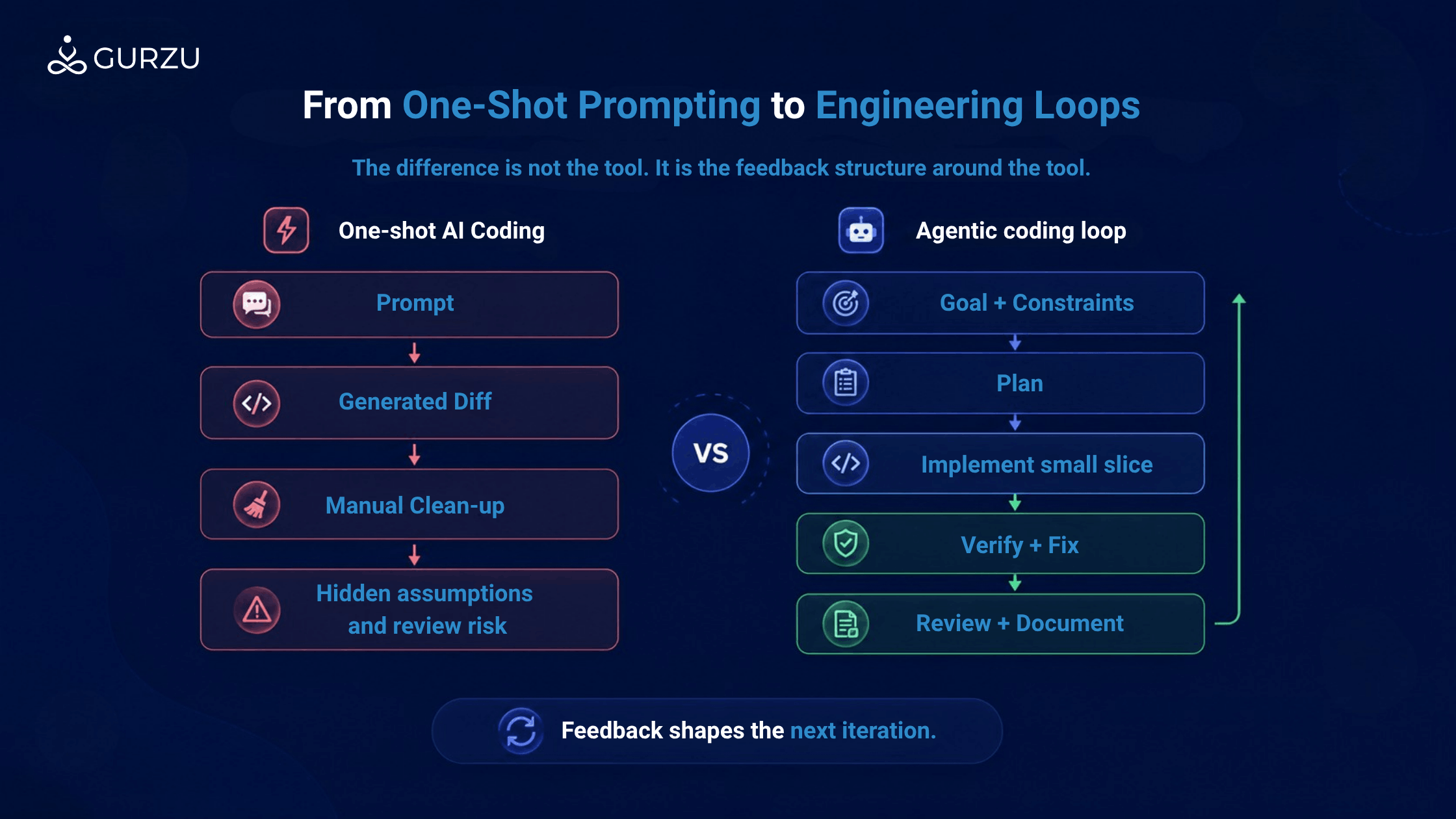
Figure 1: One-shot prompting leaves the engineer with cleanup risk. Looping workflows create checkpoints before code reaches review.
What Is Agentic Coding?
Traditional AI coding assistance usually feels like autocomplete or snippet generation. You write a comment, select a function, or ask for a small example, and the model suggests code. That can be helpful, but the scope is usually local.
Agentic coding goes further. A coding agent can inspect a repository, read multiple files, reason about relationships between modules, propose an implementation plan, edit code, run commands, read failures, and iterate. Instead of only generating a function, the agent can participate in a development workflow.
Tools such as OpenAI Codex, Claude Code, GitHub Copilot coding agent, Cursor, Windsurf, and similar IDE or terminal agents are all moving in this direction. The exact tool matters less than the operating model. The engineer defines the goal, gives context, approves direction, verifies output, and owns the result.
A useful way to describe the shift is this:
Traditional AI coding:
Generate this function.
Agentic coding:
Understand this bug, inspect the relevant files, propose a plan, implement the fix, run the checks, and report what changed.
The important point is that agentic coding does not remove engineering responsibility. It changes where engineers spend their attention. Instead of typing every line manually, the engineer spends more time defining intent, setting constraints, reviewing plans, validating behavior, and deciding whether the change is safe to ship.
Why Looping Workflows Matter?
Software engineering is already loop-based. We rarely build reliable software in one pass. We understand requirements, inspect existing code, design an approach, implement a small change, run tests, fix failures, review the diff, and improve the next version. Agentic coding works best when it follows the same discipline.
A one-shot prompt gives the agent only one chance to be right. A loop gives it feedback. That feedback may come from a human review, a failing test, a type checker, a linter, a runtime error, a security scan, a browser interaction, or a teammate’s PR comment.
The core loop looks like this:
Goal -> Context -> Plan -> Review -> Implement -> Verify -> Fix -> Review Again -> Document -> Repeat
That may look simple, but it changes the entire relationship with the agent. The agent is no longer rewarded for producing the largest possible diff. It is guided toward producing smaller, reviewable, testable progress.
This also makes AI-assisted work more transparent for the rest of the team. A teammate reviewing the PR can see not only the final code, but also the reasoning, tests, constraints, and known risks behind it.
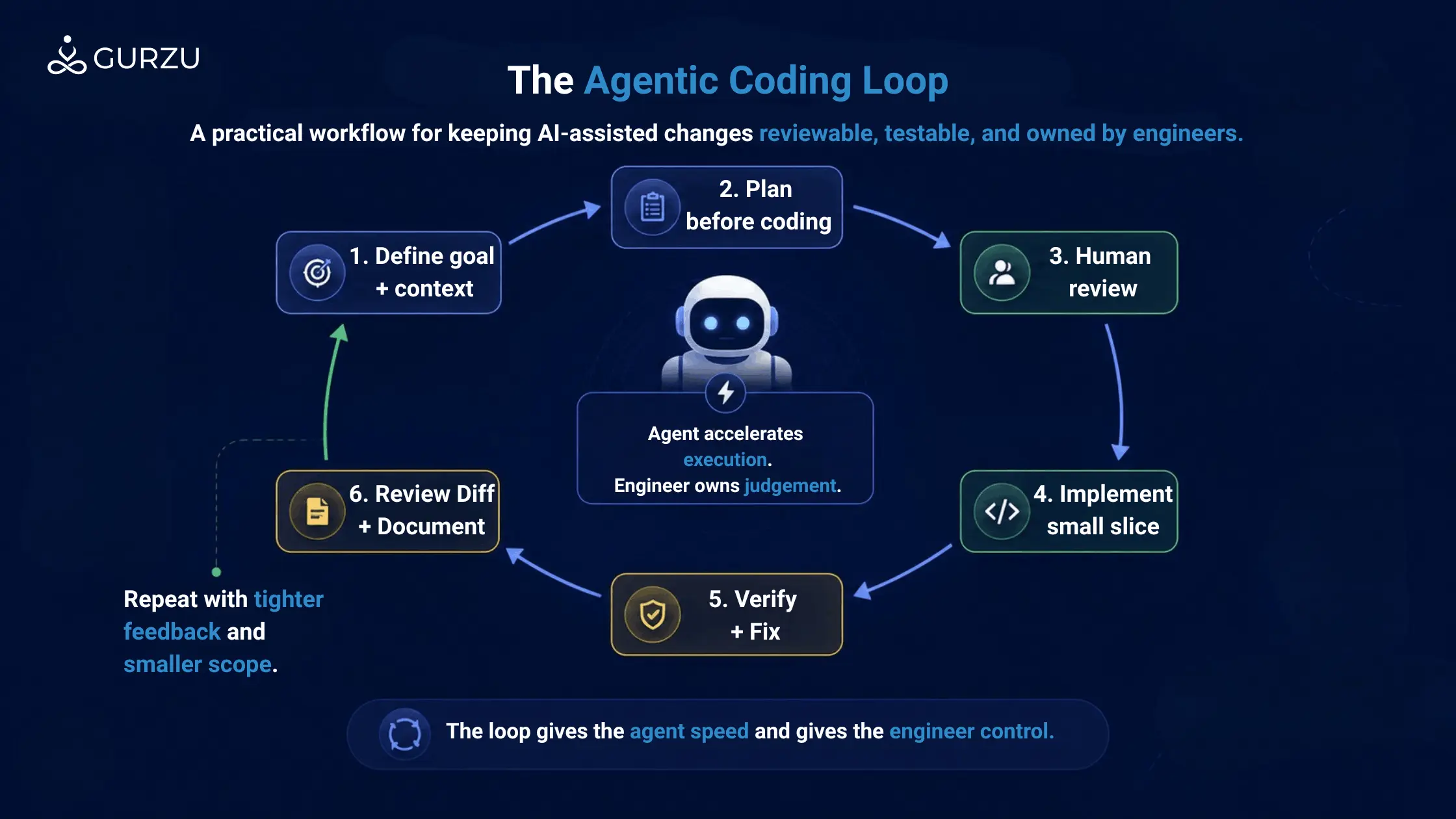
The Core Agentic Coding Loop
A practical agentic coding session should start with a clear definition of the task and end with a reviewable change. The workflow does not need to be heavy, but it should be explicit.
- Define the goal and the expected behavior.
- Provide the relevant context, constraints, and definition of done.
- Ask the agent to inspect before changing code.
- Review the proposed plan before implementation starts.
- Let the agent implement one small slice at a time.
- Run focused checks: tests, linting, type checks, or reproduction steps.
- Feed failures back into the agent and ask for targeted fixes.
- Review the final diff as a human engineer.
- Update documentation, runbooks, or PR notes where needed.
- Repeat until the change is safe enough to move into the normal review process.
For example, instead of asking an agent to “fix the settings bug,” the engineer can define the workflow more precisely:
Goal:
Fix the issue where saving user settings shows a success message but does not persist the change.
Constraints:
- Do not change the API response shape.
- Keep the patch minimal.
- Add or update a regression test if feasible.
Workflow:
Reproduce the bug.
Identify the smallest failing path.
Propose a fix before editing.
Run the focused test.
Re-run the reproduction steps.
Summarize changed files and remaining risks.
This kind of instruction gives the agent a path to follow and gives the engineer checkpoints to inspect. It also prevents the most common failure mode: turning a focused bug fix into an uncontrolled refactor.
Planning Loop
The planning loop is the first major upgrade from prompting to workflow design. Before the agent writes code, ask it to understand the codebase and explain how it intends to solve the problem.
This is especially useful for multi-file changes, unfamiliar modules, legacy code, architecture-sensitive work, and tasks where the first obvious solution may be wrong. A planning loop helps expose assumptions while they are still cheap to correct.
Before making any changes, inspect the relevant files and propose an implementation plan.Include:
- Files likely to change
- Existing patterns to follow
- Risks or assumptions
- Tests that should be added or updated
- Any questions that block implementationDo not edit files yet.
A good plan does not need to be long. It needs to be specific. It should identify the code paths involved, the expected behavior, the verification strategy, and the boundaries of the change.
In practice, I often use this loop to force the agent to slow down. If the plan mentions files that seem unrelated, misses an important test area, or assumes behavior that the product does not support, I can correct it before any code changes are made.
Planning is not bureaucracy. It is a cheap risk reduction.
Implementation Loop
Once the plan is clear, the implementation loop should still stay small. One of the easiest mistakes in agentic coding is giving the agent permission to complete the entire task in one pass. That may work for small changes, but for anything meaningful, it often produces a diff that is harder to review than to rewrite.
A better approach is to let the agent implement one logical slice at a time. For example, first update the backend validation, then add the test, then update the UI state handling, then update documentation if needed.
Implement only step 1 from the approved plan.\ Constraints:
- Keep the change minimal.
- Follow existing project conventions.
- Do not refactor unrelated code.
- Do not change public API behavior unless the plan explicitly says so.
- Stop and explain if another file needs to change.
This pattern keeps the engineer in control without requiring the engineer to manually write every line. The agent handles the mechanical work; the engineer controls scope, architecture, and quality.
The implementation loop is also where repository conventions matter. If your codebase has clear examples, consistent test structure, readable naming, and reliable setup commands, the agent has better patterns to follow. If the codebase is inconsistent, the agent will often mirror that inconsistency.
Test-Fix Loop
The test-fix loop is the highest-leverage part of agentic coding. It gives the agent an objective signal. Instead of asking “does this look right?”, you give it a command that can pass or fail.
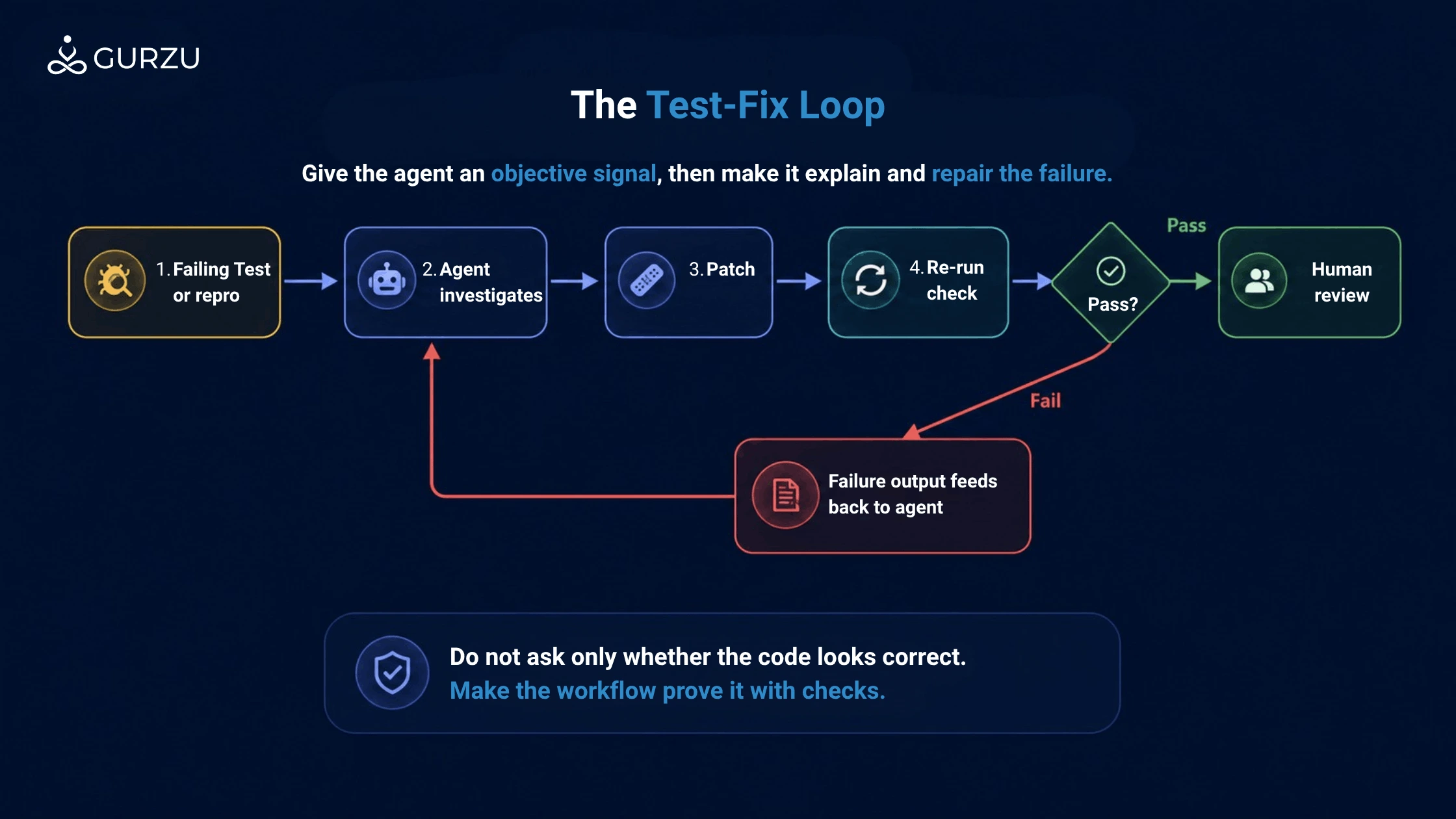
This matters because AI-generated code can sound convincing even when it is wrong. A passing test is not perfect proof, but it is stronger than confidence. A failing test is even more useful because it gives the agent concrete feedback to act on.
Run the smallest relevant test suite for this change.
If it fails:
- Explain the failure.
- Fix only the root cause of that failure.
- Re-run the same test.
- Then run the standard lint or type check if available.
Report the exact commands and results.
The phrase “smallest relevant test suite” is important. Running every test after every tiny edit can be slow and expensive. Running no tests leaves the agent guessing. Start with the most focused verification, then expand outward before the final review.
In a strong test-fix loop, the agent should not simply patch until the error disappears. It should explain what failed, why the patch addresses the failure, and whether the fix introduced any trade-offs. That explanation gives the engineer something to review instead of asking them to trust the agent blindly.
For teams adopting agentic coding, this is also a reason to invest in better tests. Tests are not only for humans anymore. They are feedback channels for agents. The more reliable your tests are, the more useful your agents become.
Review this diff as a senior engineer.
Focus on:
- Logic bugs
- Behavioral regressions
- Missing tests
- Security concerns
- Performance issues
- Unnecessary complexity
- Places where the change violates existing project patterns
Do not summarize first. List findings by severity.
This loop is useful because the agent can often spot inconsistencies in its own output when asked to review from a different perspective. It may notice missing tests, duplicated logic, unused code, or a risky assumption that was not obvious during implementation.
Still, the human engineer owns the merge decision. AI review can reduce noise and catch obvious issues earlier, but it cannot fully understand every business rule, production constraint, customer expectation, or team trade-off. It is a review assistant, not the final reviewer.
Documentation Loop
Documentation is often where otherwise good changes become incomplete. A feature is implemented, tests pass, and the PR is merged, but the README, setup guide, environment variables, API notes, or runbooks are left behind.
Agentic coding makes documentation updates easier because the agent already has the final diff in context. Use that moment to ask whether docs need to change. The important rule is to document what helps future engineers, not every implementation detail.
Based on the final diff, identify whether documentation should be updated.
If yes:
- Update only the relevant docs.
- Keep the explanation concise.
- Do not document obvious implementation details.
- Add a PR summary with what changed, how it was tested, and known limitations.
This loop is especially helpful for deployment changes, configuration updates, API behavior changes, onboarding steps, operational runbooks, and troubleshooting guides. It also improves PR quality because reviewers can quickly understand the intent, scope, verification, and risk of the change.
Team-Level Practices
Individual prompting skills help, but team-level practices matter more over time. A team that wants productive agentic coding should invest in the same things that make human engineering better: clear conventions, reliable tests, good documentation, secure defaults, and review discipline.
One practical step is to maintain a dedicated instruction file for agents. Depending on the tool, this may be an AGENTS.md file, CLAUDE.md file, Copilot instructions file, or another project-level guide. The point is to give agents predictable context about how the repository works.
- Document setup, build, lint, and test commands.
- Describe architecture boundaries and ownership rules.
- List coding conventions that are not obvious from the code alone.
- Mention files, modules, or commands the agent should avoid without approval.
- Keep CI reliable so agents and humans can trust feedback.
- Use PR templates that require test results and risk notes.
- Sandbox autonomous work where possible, especially when agents can run commands.
- Limit permissions for tools connected to production systems or sensitive data.
Advanced workflows are also emerging: parallel agents working in separate branches, one agent implementing while another reviews, recurring documentation or dependency-update agents, and tool-connected agents that can inspect issues, logs, dashboards, or test environments. These workflows can be powerful, but they also increase the need for permissions, observability, and human review gates.
A good adoption path is to begin with documentation updates, test generation, small bug fixes, and routine refactors. Then move toward small features with clear acceptance criteria. Save multi-agent or autonomous workflows for teams that already have strong CI, code review, and rollback discipline.
When to use agentic coding loops?
- Good fit: bug fixes with clear reproduction steps, test coverage improvements, documentation updates, focused refactors, and small to medium features with clear acceptance criteria.
- Use extra care: security-sensitive logic, authentication and authorization, database migrations, production deployment changes, ambiguous product behavior, and large refactors in weakly tested areas.
What Not to Delegate?
The goal of agentic coding is not to delegate judgment. It is to delegate execution while preserving judgment.
There are areas where AI assistance can help but should not be trusted blindly:
- Final architecture decisions.
- Ambiguous product behavior or business rules.
- Authentication, authorization, and access-control logic.
- Security-sensitive changes without expert review.
- Database migrations without rollback planning.
- Production deployment decisions.
- Compliance-sensitive workflows.
- Large refactors in areas with weak test coverage.
- Changes where the agent has no reliable way to verify the result.
A useful question is not only, “Can the agent do this?” A better question is, “Can the agent verify this, and can I review the result confidently?” If the answer is no, the task needs a tighter loop, stronger tests, smaller scope, or direct human implementation.
This mindset keeps the workflow honest. AI agents can accelerate many parts of software delivery, but they do not remove accountability.
Conclusion: AI Agents Accelerate Execution; Engineers Still Own the Outcome
Agentic coding is most valuable when it is treated as an engineering workflow, not a shortcut around engineering discipline. The agent can help inspect code, draft plans, implement changes, run tests, fix failures, review diffs, and update documentation. But the engineer still owns the context, constraints, verification, and final decision.
For me, the most useful shift has been moving away from one-shot prompts and toward repeatable loops. A good loop slows the agent down just enough to make its speed useful. It creates checkpoints, gives the agent feedback, and keeps the final change understandable.
The future of productive software engineering is not just better prompts. It is better loops. Engineers who learn to design those loops will get more value from AI tools without sacrificing the quality of the systems they build.
Related Gurzu Reading
- Agentic Engineering in Practice: Bringing a Vibe-Coded Rails Project Back to Life
- AI-Augmented Engineering Playbook: Why Judgment Matters More Than Ever
- AI Governance for Developers: What Engineers Should Know Before Shipping AI Features
- Building Fast, Launching Smart: Quality Validation for AI-Assisted Products
Further Reading and Source Notes
This article combines practical workflow patterns from my own agentic coding experience with publicly documented practices from current AI coding tools and engineering teams. The sources below are useful for readers who want to explore the tooling side in more detail.