We’ve worked with Shopify long enough to know it’s one of the best platforms available for modern e-commerce. It gives merchants a polished storefront, a reliable checkout experience, and a mature ecosystem that helps brands scale quickly.
New to Shopify? Care for a quick read - Grow your eCommerce Business with Shopify
But if you’ve ever tried to set up Shopify in Nepal, the gaps become obvious very quickly. Shopify doesn’t natively support Nepal’s most widely used payment methods. It also doesn’t integrate directly with local logistics providers.
That means merchants can launch a beautiful storefront, but still end up manually confirming orders, coordinating deliveries over phone calls, and handling payment verification outside the platform.
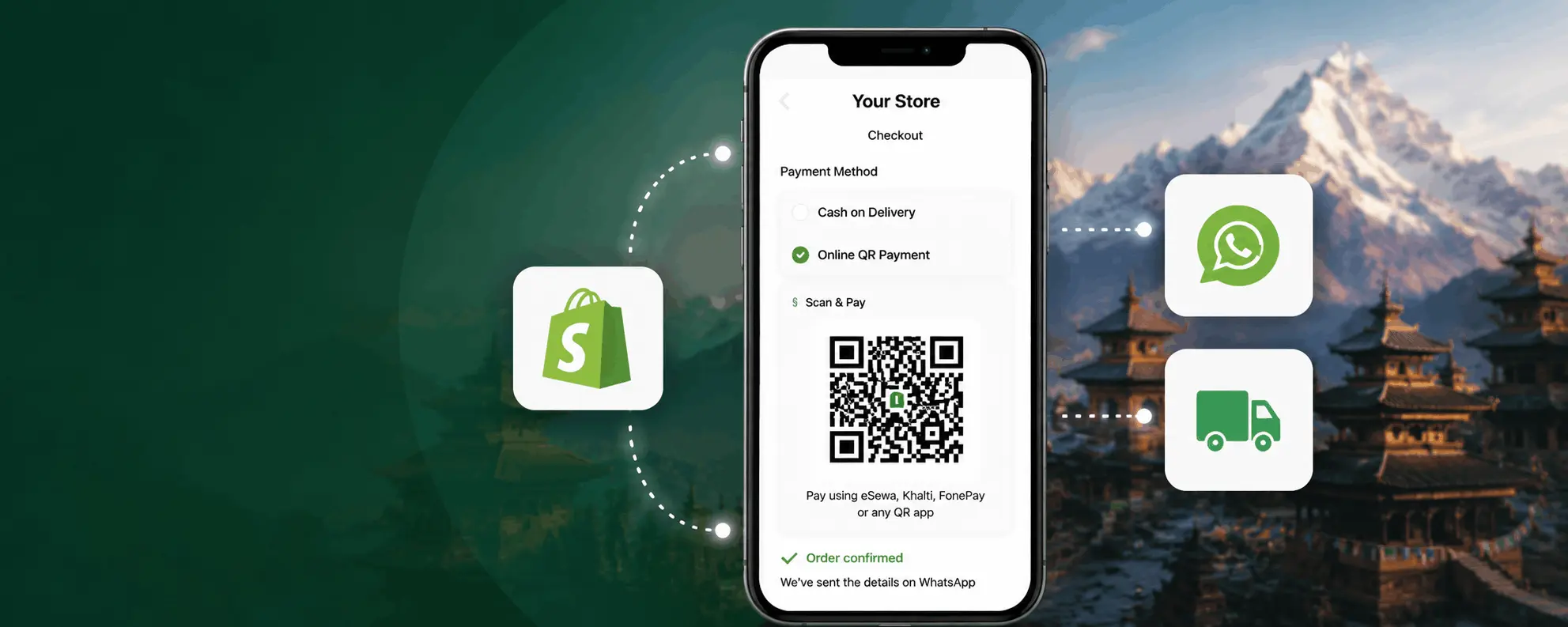
For one of our clients, a growing e-commerce brand in Nepal, that became the biggest challenge. They wanted the best of both worlds: Shopify’s sleek storefront experience and the ability to actually get paid along with an automated order delivery.
The question wasn’t whether Shopify was the right platform. It was how to make Shopify work within Nepal’s local infrastructure, the way customers in Nepal actually shop and pay.
The challenge: A Global Platform in a Local Market
Shopify is one of the most powerful e-commerce platforms in the world. It handles storefronts, product catalogs, inventory, checkout, everything a growing brand needs. But when it comes to payments, it defaults to globally supported payment gateways.
The problem became clear almost immediately: the checkout couldn’t actually complete a transaction in Nepal. Nepal’s most reliable payment methods, eSewa, Khalti, FonePay, aren’t supported by Shopify. Beyond payments, Shopify doesn’t natively support direct integrations with local logistics partners, meaning order fulfillment had to be managed manually.
So you have a functioning storefront that can’t take payments, can’t talk to your delivery network, and requires manual intervention on every order.
Our client had two choices: move away from Shopify, or find a way to make Shopify work in a market it wasn’t built for.
Our Approach: A Custom Engine That Connects Everything
The client was right that Shopify was the right platform for their needs. So, rather than moving away from Shopify or building an entirely new platform from scratch, we needed a layer that sits between Shopify and the local infrastructure and makes them speak to each other.
The core of our solution was a custom lightweight middleware layer, an engine built as a Shopify extension.

The goal was simple:
- keep Shopify as the core commerce engine
- extend its capabilities through custom integrations
- make the experience feel native for Nepali customers
The Customer Experience
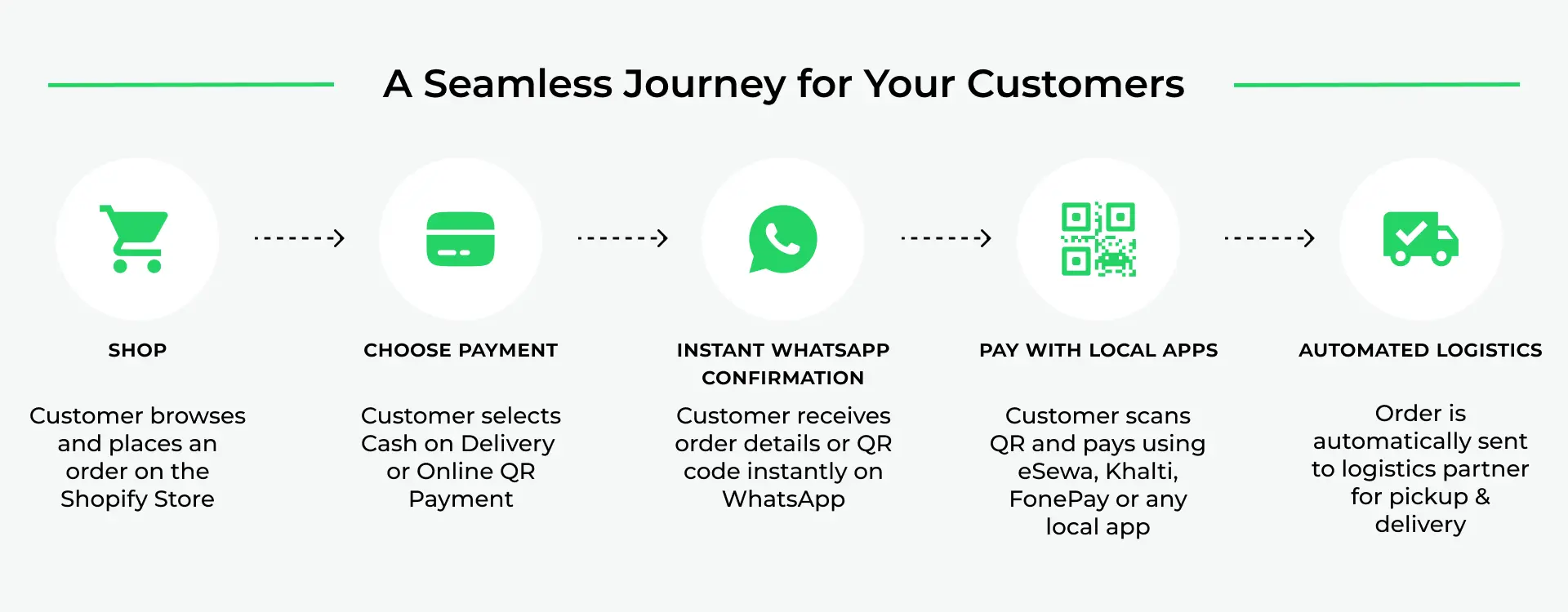
From the customer’s perspective, the buying journey remained simple and familiar.
They browsed the Shopify storefront normally, added products to their cart, and proceeded through checkout like any standard e-commerce experience.
At checkout, customers could choose between:
- Cash on Delivery
- Online QR Payment
That single decision triggered two different automated flows.
- Cash on Delivery: Instant Confirmation Through WhatsApp. For COD orders, the system automatically detected the selected payment method and triggered a WhatsApp confirmation message immediately after checkout. No QR code, no payment action needed - just a clear, friendly confirmation that their order is placed and on its way.
- Online QR Payment: Pay Right from WhatsApp. For customers who choose online payment, the experience became even more localized. Once the order was placed, the customer received a dynamic QR code directly through WhatsApp. The QR was generated specifically for that order and could be scanned using local payment apps like eSewa, Khalti, or QR-compatible banking apps connected through Fonepay. No redirects, no confusion.
- Automating Logistics. Payments were only part of the problem. Once an order was confirmed, the next challenge was fulfillment. Shopify’s native setup didn’t support direct coordination with the client’s local logistics workflow. Without automation, the team had to manually process dispatch requests for every order. To solve this, our middleware layer automatically triggered logistics requests once payment or order confirmation was completed.
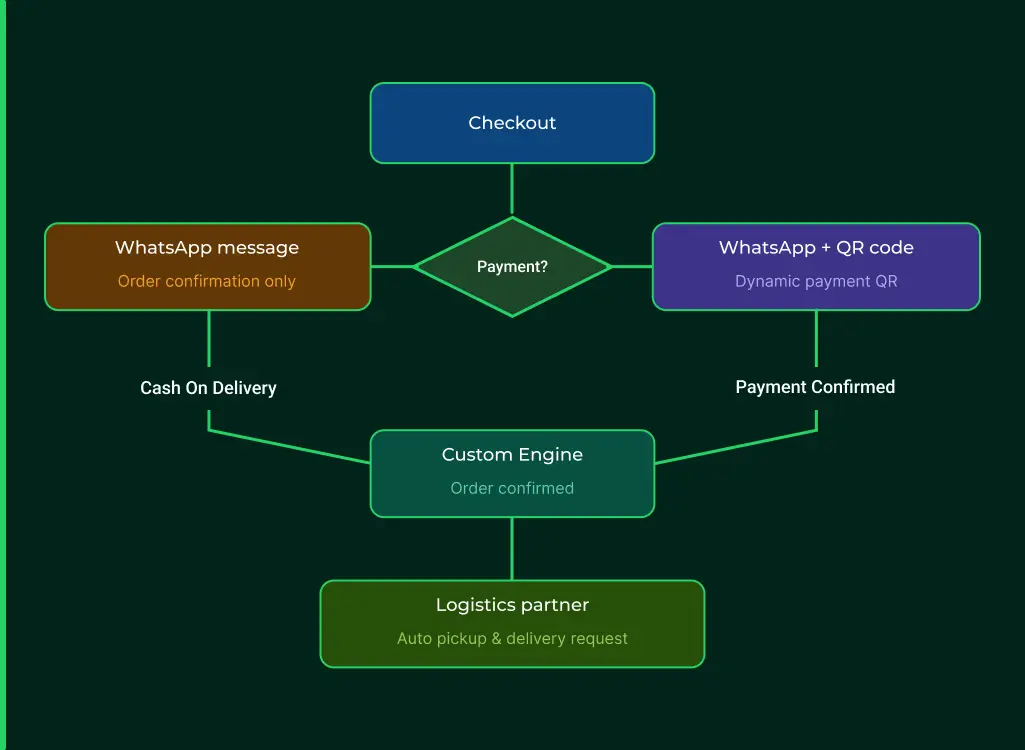
On top of the extended flow, Shopify’s standard order confirmation was as usual, so customers have a paper trail, and the business keeps its professional communications intact.
Why WhatsApp? Why Not Just Email?
One of the most effective parts of the solution wasn’t the payment system itself. It was the communication layer around it.
In Nepal (and across South Asia), WhatsApp isn’t just a messaging app, it’s how people communicate for everything, including business. An order confirmation landing in someone’s WhatsApp inbox feels immediate, personal, and trustworthy in a way that email often doesn’t.
- For COD customers, a WhatsApp message created confidence that the order has been successfully received.
- For online payment customers, it reduced friction by delivering the payment action directly into the same conversation where they received confirmation.
- Instead of asking customers to switch contexts between websites, emails, and payment pages, the entire experience stayed within a familiar communication channel.
It’s small details like this that make a global platform feel native to how customers actually live and shop.
What This Meant for the Business
For our client, this wasn’t just a technical workaround. It was a business unlock. They could continue managing products and orders directly from Shopify, while the operational complexity ran quietly in the background.
It allowed the client to operate Shopify in Nepal, where,
- COD communication became fully automated
- QR payments worked through familiar local payment apps
- Logistics requests were triggered automatically
- Operational overhead dropped significantly
- The entire workflow became faster and more reliable
Reflection
What this project taught us is that localizing a global platform isn’t the platform itself, it’s the gap between global platforms and local infrastructure.
E-commerce space is growing fast. Consumers are getting more comfortable buying online. Brands are investing in their digital presence. But the local infrastructure, payment systems, logistics, customer communication, is still catching up to global platforms. It’s the small details that makes the whole experience feel native to how customers actually live and shop. This is a good reminder that the best solutions aren’t always about using the newest tools, but sometimes they’re about making existing tools work for your context.
Bridging that gap requires more than theme customization or plugin installation. It requires custom engineering that adapts global platforms to local market behavior without breaking what they already do well.
That’s why we chose an extension-based architecture instead of external workarounds.
Building directly within Shopify’s extension ecosystem allowed the solution to behave like a native part of the platform while remaining easier to maintain and evolve over time.
As Shopify continues expanding into newer markets, we believe this kind of localization work will become increasingly important, especially in regions where payment systems, logistics networks, and customer behavior differ from the assumptions built into global platforms.
Quick Read: Need help Building Your First Shopify App?
If you’re a business trying to build on a global platform while serving a local market, the answer usually isn’t to choose one or the other. With the right approach, you can have both.
We’re a Shopify development team based in Nepal. If you’re an Agency, Merchant, or Shopify Partner working on similar challenges in emerging markets or otherwise feel free to reach out.
At Gurzu, we help startup founders translate their vision into impactful products that stand out. If you’re looking to buildor need guidance on bringing your brand to life, Book a free consulting session with us or leave us a message and we will reach out to you!